Modal Verbs - Modal Verb In English Grammar Eslbuzz Learning English. A modal, also known as a modal auxiliary or modal verb, expresses necessity, uncertainty, possibility, or permission. Can (or cannot/can't) shows ability, in the sense of knowing how or being able to do something. There's a class of helper verbs known as modals that we use to express a bunch of conditions: They can also be used to form the future tense in english and to make conditional sentences. Test your knowledge of the modals!
The modal verbs in german are dürfen (be allowed to/may), können (be able to/can), mögen (to like/may), müssen (to have to/must), sollen (to ought to/should) and wollen (to want to). Modal auxiliaries denote certain feelings, moods and possibilities. This free online english language course will teach you about modal verbs. You can use them to ask for permission, give advice, determine how likely something is, and many other things besides! Modal verbs the modal verbs include can, must, may, might, will, would, should.
Modal Verbs In English English Study Here from englishstudyhere.com A modal, also known as a modal auxiliary or modal verb, expresses necessity, uncertainty, possibility, or permission. Modal verbs are common auxiliary verbs in germanic languages including english that indicate modality. Can, could, may, might, will, would, shall, should, must, ought to. A modal is a type of auxiliary (helping) verb that is used to express: A modal verb is an auxiliary verb that expresses necessity or possibility. Need and dare can be used like modal verbs modal verbs with examples Modal verbs are also sometimes called modals. The modal verbs in german are dürfen (be allowed to/may), können (be able to/can), mögen (to like/may), müssen (to have to/must), sollen (to ought to/should) and wollen (to want to).
There are ten types of modal verbs:
An auxiliary verb, also called a helping verb, helps other verbs show moods and tenses. We can use them to give advice, make guesses at how necessary or likely something is, make requests of people, and so on. They are followed directly by the infinitive of another verb (without 'to'). Since modal verbs can usually only appear in a few tenses and not in combination with other modal verbs in a sentence, they all have substitute forms that are then used in appropriate cases. Auxiliary verbs include forms of do, be, and have. The modal verb must be used in a verb phrase. A modal is a type of auxiliary (helping) verb that is used to express: Modal verbs always accompany the base (infinitive) form of another verb having semantic content. Can, could, may, might, will, would, shall, should, must, ought to. They make questions by inversion ('she can go' becomes 'can she go?'). They can also be used to form the future tense in english and to make conditional sentences. Modals are different from normal verbs: This free online english language course will teach you about modal verbs.
They don't use an 's' for the third person singular. First, they can be used when we want to say how sure we are that something happened / is happening / will happen. They are used with other verbs to express ability, obligation, possibility, and so on. Suggestions and obligations 'can' and 'could' 'may' and 'might' 'will' and 'would' 'will have' and 'would have. The sea monster should go away 'should' is the.
Test English Prepare For Your English Exam from test-english.com There are ten types of modal verbs: Modal verbs are also sometimes called modals. The modal verbs in german are dürfen (be allowed to/may), können (be able to/can), mögen (to like/may), müssen (to have to/must), sollen (to ought to/should) and wollen (to want to). Modals are different from normal verbs: Each one of the modal verbs can be used to express one or more of these modalities. You can use them to ask for permission, give advice, determine how likely something is, and many other things besides! Modal auxiliaries denote certain feelings, moods and possibilities. They express things like ability, permission, possibility, obligation etc.
They can also be used to form the future tense in english and to make conditional sentences.
Modal verbs (will, would, should, may, can, could, might, must) precede another verb. They are followed directly by the infinitive of another verb (without 'to'). The sea monster should go away 'should' is the. Modal verbs are in bold and modal adverbs are italicized. Can (or cannot/can't) shows ability, in the sense of knowing how or being able to do something. Get 3 months membership for just €10.49 (≈ $12.48). Modal verbs the modal verbs include can, must, may, might, will, would, should. They make questions by inversion ('she can go' becomes 'can she go?'). So, let's try out the quiz. A modal is a type of auxiliary (helping) verb that is used to express: Can, could, may, might, will, would, shall, should, must, ought to. The modal verb must be used in a verb phrase. We can use them to give advice, make guesses at how necessary or likely something is, make requests of people, and so on.
Modal verbs are used with other verbs to express ability, obligation, possibility, or talking about ability, asking permission, which includes modal verbs like can, could, must, may, might, and so on. Modal verbs always accompany the base (infinitive) form of another verb having semantic content. Henry stressed that he really could not (ability) attend the party, but his friends continued to insist vehemently. The modal verbs in german are dürfen (be allowed to/may), können (be able to/can), mögen (to like/may), müssen (to have to/must), sollen (to ought to/should) and wollen (to want to). Modal auxiliaries denote certain feelings, moods and possibilities.
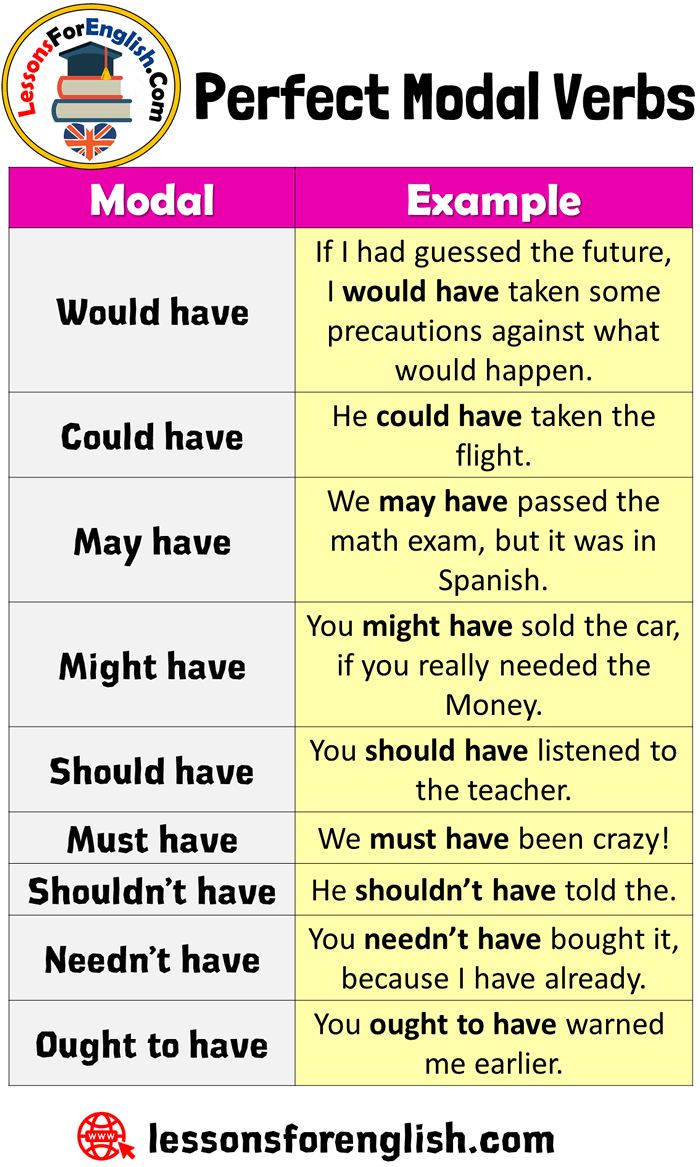
Perfect Modal Verbs List And Examples Lessons For English from lessonsforenglish.com Test your knowledge of the modals! For use in the present, see also modal verbs in the present simple. With lingolia plus you can access 13 additional exercises about modal verbs, as well as 785 online exercises to improve your english. The modal verbs in english grammar are c an, could, may, might, must, need not, shall/will, should/ought to. First, they can be used when we want to say how sure we are that something happened / is happening / will happen. This free online english language course will teach you about modal verbs. Modal verbs are always paired with at least one other verb. Modal verbs only have one form.
You can use them to ask for permission, give advice, determine how likely something is, and many other things besides!
So, let's try out the quiz. These are verbs that indicate likelihood, ability, permission or obligation. Modality is the grammaticalized expression of the subjective attitudes and opinions of the speaker including possibility, probability, necessity, obligation, permissibility, ability, desire, and contingency. Below is a list showing the most useful modals and their most common meanings: With lingolia plus you can access 13 additional exercises about modal verbs, as well as 785 online exercises to improve your english. Modal verbs are in bold and modal adverbs are italicized. In informal situations, it expresses permission, in the sense of being allowed to do something. Can, could, may, might, will, would, shall, should, must, ought to. Unlike be, have and do, the modal auxiliaries cannot function as main verbs except in few cases. Modal verbs (will, would, should, may, can, could, might, must) precede another verb. Test your knowledge of the modals! They express things like ability, permission, possibility, obligation etc. Modal auxiliaries denote certain feelings, moods and possibilities.